
AI in Medical Education India 2026: What MBBS Students in Bangalore Should Expect
AI in medical education India is no longer a distant idea. It is already in the study habits of MBBS students, the software running in hospital imaging rooms, and the conversations regulators are having about what a doctor trained in 2026 should know. But it is also an area full of loose claims. Some colleges say they are “AI-enabled” when they mean they bought a few licences. Others quietly do very good work and never put it in a brochure.
This guide separates what is real from what is marketing. It is written for parents, founders, and professionals, in India and overseas, who are weighing an MBBS seat the way they would weigh any big investment: with evidence. We will look at where AI actually stands in MBBS training, how it fits into the national curriculum, what the admission process looks like in Karnataka, and which questions to ask any college before you commit.

Where AI Actually Stands in MBBS Today
Here is the honest picture of AI in medical education India: it is changing healthcare faster than the MBBS syllabus is changing.
- There is no single national AI subject in MBBS yet. A 2026 editorial in a medical journal pointed out that formal AI literacy is still missing from undergraduate medical curricula in India, and proposed a 20-hour module inside the foundation course to fix that.
- Regulators are paying attention. At a medical education forum in August 2026, the chairperson of the National Medical Commission said medical education must prepare students to understand and use AI responsibly, while accountability stays with the doctor. He also cited data that nearly 50,000 doctors completed structured online AI training during 2026.
- Students are interested but still learning. A 2026 study of undergraduate students at a teaching institute found average AI readiness and mixed-to-positive attitudes, with many students staying neutral.
So when a college says it is “integrating AI”, the useful question is how. A syllabus change, a simulation lab, a learning platform, and a one-day workshop are very different things.

Competency-Based Medical Education India Style: Why AI Fits Naturally
To understand where AI can help, it helps to know how MBBS is taught now.
The competency-based medical education India rolled out in 2019 changed MBBS from a course that rewarded memory to one that rewards what a student can actually do. Instead of only asking “what do you know?”, the system asks “can you take a history, read an ECG, explain a diagnosis to a patient, and know when to ask for help?” The National Medical Commission’s updated curriculum also stresses digital preparedness.
This shift opens the door for AI in three practical ways:
- Self-directed learning is now part of the curriculum. The NMC treats self-directed learning as an essential element of MBBS, because medical knowledge grows too fast for any student to depend only on lectures. AI study tools slot in here.
- Skills are assessed, not just recalled. Simulation and skills labs let students practise procedures safely before touching a patient.
- Lifelong learning is the goal. A doctor who graduates in 2031 will use tools that do not exist today. Training students to question and verify those tools matters more than teaching any one product.
One 2026 study gives a useful reality check. Medical students who used generative AI to build self-directed learning material finished the task about 43 percent faster. But the authors also warned about accuracy errors, academic honesty, and over-reliance, and recommended teaching “verification” as a core skill. That is the right lesson. Speed is easy. Judgement is the hard part.
Five Places AI Shows Up in MBBS Training
Not every college does all of these. Treat this as a map of what is possible, then ask each college which parts it actually offers.
1. AI-Assisted Self-Study
Students use AI tools to summarise topics, create practice questions, and check understanding. Done well, faculty teach students how to cross-check outputs against standard textbooks. Done badly, students copy answers they do not understand.

2. Simulation and Skills Labs
Mannequins, procedural trainers, and virtual patient cases let students practise before real patients. Some systems add automated feedback on technique. The NMC has also pushed for skills labs with simulation equipment in medical colleges.
3. Exposure to AI in Imaging and Diagnostics
Hospitals increasingly use software that flags findings on chest X-rays, CT scans, and pathology slides. An MBBS student who rotates through radiology and pathology should see how these tools support, but do not replace, a clinician’s reading.
4. Digital Libraries and Learning Platforms
Online journals, recorded lectures, adaptive question banks, and digital libraries make it easier to study across sites and revise on demand. They are not glamorous, but they are often where colleges make the biggest real difference.
5. Ethics, Privacy, and Verification
Students need to know when not to trust a tool, how patient data must be protected, and who is responsible when AI is wrong. In medicine, the answer is always the doctor.
What AI Cannot Replace in a Doctor
It is worth saying plainly: AI is a tool, not a substitute for clinical training.
- Hands-on practice. No software can teach a student to examine an abdomen or deliver bad news kindly.
- Communication. Programmes like the Family Adoption Program in the NMC curriculum exist precisely to build communication and community skills.
- Judgement under uncertainty. Real patients rarely look like textbook cases.
- Ward culture. Learning how a team works, how handovers happen, and how to escalate a problem comes from time in a real hospital.
For this reason, a college’s attached teaching hospital, patient load, and faculty quality still matter more than any technology label.
Medical Colleges in Bangalore for MBBS: The Landscape
Karnataka is one of the biggest destinations for MBBS in India. Recent counselling data reports about 14,000 MBBS seats across 74 medical colleges in the state, with roughly 72 percent of those seats in private colleges. That gives families a wide choice, which is both a benefit and a source of confusion.
When families search for medical colleges in Bangalore for MBBS, they often compare fees, rank, and distance. A more useful checklist adds teaching hospital access, simulation facilities, digital resources, faculty stability, and how the college handles student support.
If you are searching for the best medical colleges in Bangalore, remember that “best” depends on what you need. A college with a large teaching hospital and strong clinical exposure may suit one student, while another may prioritise campus support, a quieter location, or flexible fee options.
MBBS Admission Bangalore 2026: How the Process Works
For anyone planning MBBS admission Bangalore 2026 or the next cycle, the basics are straightforward even if the paperwork is not.
- NEET UG is compulsory. Admission to MBBS in Karnataka, in both government and private colleges, depends on NEET UG scores.
- KEA runs the state counselling. The Karnataka Examinations Authority conducts counselling for state quota seats and for private college seats. Students register online, submit documents, fill in college and course choices, and wait for allotment across rounds.
- All India Quota runs separately. Central counselling covers its own share of seats, which is why many families register for both.
- Seat categories matter. Government quota, private quota, management, and NRI seats each have different eligibility rules and fee structures, so read the notification carefully.
Counselling is run in multiple rounds, followed by mop-up and stray vacancy rounds. If you are reading this late in the 2026 cycle, check the KEA website for current round status and vacancies instead of relying on older blog posts. For families planning ahead, the official KEA portal and the National Medical Commission are the places to confirm recognition status, seat matrices, and dates.
One practical tip for working parents: keep documents ready well before registration opens. Caste, domicile, and income certificates can take weeks to obtain, and a missing document is one of the most common reasons families lose time.
What to Ask Any College About AI and Technology
Before paying any deposit, ask these questions about AI in medical education India at every college you shortlist. A good college will answer plainly.
- Is there a simulation or skills lab, and how many hours of practice does each student get?
- Which digital learning resources do students use, and are they included in fees?
- How are students taught to use AI tools responsibly, and what is the policy on academic honesty?
- Does the attached hospital use digital records or AI-supported imaging, and do students rotate through those departments?
- How is the college delivering competency-based medical education India requires, and how are skills assessed?
- What faculty training exists on new technology? Students benefit only if teachers are comfortable with the tools.
Parents who compare medical colleges in Bangalore for MBBS using this list will learn more in one visit than from any ranking table.
Akash Group of Institutions: Technology-Ready Medical Training in Devanahalli
Among medical colleges in Bangalore for MBBS, Akash Group of Institutions is a multidisciplinary campus in Devanahalli, offering over 70 programmes across medicine, engineering, nursing, pharmacy, and allied health. Its medical arm, the Akash Institute of Medical Sciences and Research Centre, trains students with an attached hospital, which gives MBBS students regular clinical exposure alongside classroom learning.
A few features matter for the questions above:
- An attached teaching hospital for clinical postings and patient contact.
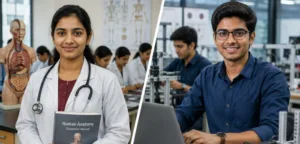
- Simulation centres and specialised labs, including anatomy and pathology, for skills practice.
- A digital library and modern learning resources for self-directed study.
- A multidisciplinary environment, where medical, nursing, allied health, and engineering students share a campus. For students interested in the technology side of healthcare, that mix can be a real advantage.
- Location: A green campus near Kempegowda International Airport, which suits families who travel often.

Technology adoption in medicine changes fast, so we suggest asking the admissions team directly about current simulation and digital tools, how AI literacy and ethics are covered in teaching, and how students are supported through the first year. A campus visit, with time in the labs and the hospital, will tell you more than any website.
FAQs: AI and MBBS Training
Q: What is AI in medical education India, in simple terms? A: It means using artificial intelligence tools to support how doctors are trained, such as study assistants, simulation feedback, and exposure to AI-supported imaging, while teaching students to use these tools safely and verify results. It sits alongside, not in place of, hands-on clinical training.
Q: Is AI a compulsory subject in MBBS now? A: Not as a standalone national subject, as of 2026. Researchers and regulators are discussing AI literacy and ethics, and some colleges add their own modules, but the standard MBBS curriculum is still built around competencies, clinical skills, and self-directed learning.
Q: What is the competency-based medical education India follows, and where does AI fit? A: It is the MBBS curriculum introduced nationally in 2019 that focuses on what students can do, not just what they remember. AI fits mainly through self-directed learning, simulation, and digital resources, with a growing focus on responsible use.
Q: How do I choose among medical colleges in Bangalore for MBBS? A: Compare the attached teaching hospital, patient load, simulation and digital facilities, faculty stability, regulatory recognition, fees, and student support. Visit the campus and talk to current students if you can.
Q: What are the key steps for MBBS admission Bangalore 2026? A: Qualify NEET UG, register for Karnataka counselling with KEA (and for central counselling if eligible), upload documents, fill in college preferences, and follow the allotment rounds. Check the KEA website for current dates, vacancies, and seat categories.
Q: Will AI replace doctors? A: Current evidence and regulator statements point to AI supporting doctors, not replacing them. Accountability for patient care stays with the clinician, which is why training now stresses judgement, ethics, and verification.
Final Thoughts
AI in medical education India will shape the careers of today’s MBBS aspirants, but the foundation of a good doctor has not changed: strong clinical training, sound judgement, and the ability to learn for life. The smartest approach is to look for colleges that treat technology as a support for that foundation, not a slogan.
If you are shortlisting medical colleges in Bangalore for MBBS, including for MBBS admission Bangalore 2026 or the next cycle, speak with the admissions team at Akash Group of Institutions. They can walk you through the medical programme, the attached hospital, the labs, and the current admission process, so you can compare real facilities instead of promises.